%20(2).png)
7 min
SaaS Product Design Agency Pricing: What to Expect in 2026
What does SaaS product design agency pricing look like in 2026? Real US benchmarks for audits, redesigns and retainers, plus the costs quotes leave out.
Read More


Published
April 8, 2026

Every week, a Series A SaaS founder in the US opens a browser and searches for a product design agency. By the end of that search, most of them are more confused than when they started.
The options look identical all claiming "user-centered design," "end-to-end UX," and some variation of "we help startups scale." The portfolios blur together. The pricing pages say "custom quotes."
And so the founder ends up on a call and that's where the real evaluation begins.
We've had dozens of those calls at Fluidesigns. With Series A and B SaaS founders, heads of product, and CPOs from the US and beyond. And what's become clear is this: founders aren't just evaluating your work. They're evaluating whether you understand their world.
This post breaks down the seven things high-growth SaaS founders actually look for before hiring a product design agency and what great answers to each of those questions look like.
The first thing a seasoned SaaS founder wants to know isn't about your design tools or your process deck. It's whether you can hold a product conversation.
In one of our early pre-sales calls with a data analytics SaaS (Amazon seller intelligence, ~50 employees), the first thing the founder did was share their product screens and ask us what we noticed. Not "can you redesign this?" but "what's broken, and why?"
They wanted to see if we'd identify the right problems: inconsistent information hierarchy, low data density, no bulk action support, a table UX that didn't scale past 30 items. They weren't looking for enthusiasm. They were looking for vocabulary proof that we'd done this before, in similar contexts.
What this means for you as a founder: Before signing any agency, run a design audit session. Share 2-3 screens and ask them what they'd prioritize fixing and why. The quality of that answer tells you more than any proposal.
What good agencies do: They spot systemic problems, not cosmetic ones. They ask questions about user behavior, drop-off data, and business goals not just whether the colors look good.
This is one of the most common frustrations we hear from founders at Series A and B: engineering moves fast, product is shipping weekly, but design is still the slowest link in the chain.
The typical pattern looks like this the product manager has a feature idea, gets it scoped by engineering, but then has to wait two weeks for design to produce screens. By the time design delivers, half the context has shifted. The engineering team is impatient. The founder is frustrated.
What founders want to know is: can your agency actually keep up?
Here's what we've seen work for product teams that ship at speed:
Async-first collaboration. The best engagements don't run on weekly calls. They run on Figma comments, Loom walkthroughs, and Slack threads. An agency that requires a scheduled meeting to share feedback will always be a bottleneck.
Component-based design systems. When your product has a well-maintained design system, new features become compositional rather than bespoke. Every new screen doesn't need to be designed from scratch it's assembled from components that already follow your brand and interaction rules. This is where upfront investment in design systems pays back at 3x.
AI-assisted prototyping. We use Claude, Figma MCP, and tools like Aura.build to generate and iterate on design options far faster than traditional workflows allow. This means we can often present two or three directions in the time it previously took to produce one and push updates directly back into Figma for dev handoff.
Flexible scope management. Some weeks a product team needs five screens. Other weeks, they need thirty. An agency that can flex with your sprint cadence rather than locking you into a fixed monthly deliverable list is genuinely more valuable for high-growth teams.
The signal to look for: Does the agency ask about your sprint cadence and engineering process before talking about their own design process? If not, they're likely built for waterfall not the pace you're running at.
SaaS founders are operational people. They want to know exactly what they're buying. Vague answers here are a red flag because vagueness in process usually means vagueness in delivery.
But here's something equally important: every SaaS company works differently. Some teams want a linear, stage-gated process with clear sign-offs at every step. Others can't articulate what they want until they see something visual they think through reactions, not requirements. A good agency recognizes this and adapts.
Here's the process we follow, roughly in sequence, though the emphasis and pacing flex based on how the client team actually works:
Product Discovery Sprint A structured workshop to understand your ICP, your product's core jobs-to-be-done, your users' mental models, and what success looks like. We build a shared project knowledge base from this that informs everything downstream.
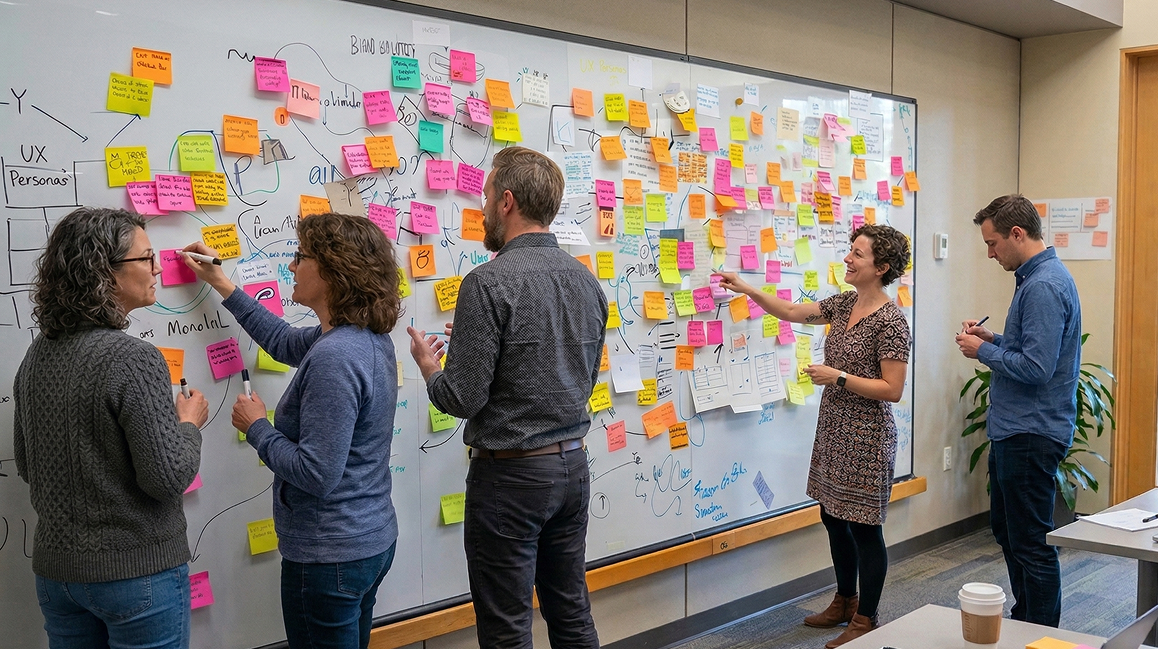
Competitive Analysis + UX Audit We map your competitive landscape and, if you have an existing product, run a heuristic evaluation to identify friction points and hierarchy problems. We use AI tools at this stage to accelerate pattern recognition across competitor UIs.
User Flows + Journey Mapping - Before touching Figma, we map the end-to-end user journeys we're designing for from awareness to activation to retention. This phase surfaces logical gaps and edge cases that would otherwise become expensive rework later.
Information Architecture - How the product is structured: what lives where, how navigation is organized, how users move between states. Getting this right before wireframing saves weeks.
Wireframes - Low-fidelity screens that lock in structure and logic before visual design begins. For teams that think visually, we sometimes move through this phase quickly with rough sketches to get reactions rather than formal documentation.
Visual Design + Design System - High-fidelity screens with your brand language, component library, and design tokens. This is what gets handed to your engineering team and what creates long-term design velocity.
Prototype + Usability Testing - Clickable prototypes let us test with real users before any code is written. We use tools like Maze and Lookback for remote testing and in-session observation for nuanced feedback.
Handoff + Dev Support - Annotated Figma files, dev-ready specs, and ongoing support through the engineering sprint.
What to look for: Agencies that skip wireframes and go straight to visuals are optimizing for "wow" in the sales cycle. Agencies that skip usability testing are guessing about whether the design actually works. But also be wary of agencies so rigid about their process that they can't adapt when your team works differently.
This is probably the hardest question to get a real answer on and the most important one to ask.
The honest answer is: it depends on what you're designing and what you're instrumenting. But here's what the best SaaS companies actually track, and what we help clients set up:
For onboarding flows: Time-to-activate, step completion rates, day-7 retention. If you redesign onboarding and time-to-activate drops by 30%, that's directly attributable.
For feature adoption: Feature discovery rate (how often users find and use a new capability), session depth, and support ticket volume for that feature. A well-designed feature should require fewer support tickets, not more.
For conversion funnels: Demo requests, trial signups, or pricing page conversions. For one of our clients, Omnispay, a redesigned campaign creative generated 1,250 leads in a single week that's directly trackable.
For usability: We run usability interview sessions with actual users not just the product team's assumptions and we use session recording tools like Microsoft Clarity and LogRocket to watch real user journeys, identify rage clicks, and map drop-off points with precision.
What to ask an agency: Ask them to name a design decision from a previous project that they changed based on user data. If they can't, they're not measuring.
Most serious design agencies have a preferred engagement structure, but the best ones are willing to start small and earn the larger relationship.
Here's how we think about it:
Pod-based retainers work best for ongoing product work. Rather than billing by hour or headcount, we assemble a pod typically a senior product designer, a visual designer, and a motion designer scoped to your monthly design demand. This gives you a consistent, coordinated team without the overhead of full-time hires.
Project-based engagements are the right fit when scope is well-defined a full product redesign, a new feature suite, a website rebuild from scratch. These are fixed-scope, fixed-timeline engagements with clear deliverables.
Starting small is always an option. If you want to test the working relationship before committing to a larger engagement, we're open to starting with a focused sprint a design audit, a single feature redesign, or a landing page to build trust before going deeper.
On pricing: quality SaaS design in the US market typically ranges from $3,000 to $6,000+ per month for a retainer engagement, depending on the depth of the pod and the scope of work. Project-based engagements for a full product design typically range from $15,000 to $40,000. We don't publish fixed packages because the right engagement depends on your stage, velocity, and design maturity but we're always transparent about how we structure things when you ask.
What matters more than price: Whether the scope is defined and honored, and whether the agency can flex when your needs change. Ask what happens when you need something outside the agreed scope. Clear, reasonable answers here are a good sign.
This is the underlying question beneath all the others. And it's the one most agencies don't have a real answer to.
B2B SaaS has specific design constraints that consumer apps don't:
A generalist agency can make something beautiful. A B2B SaaS-specialized agency makes something that actually works for the people using it all day.
At Fluidesigns, roughly 60% of our portfolio is SaaS and AI product companies from GeoComply (fraud detection platform) to Voicegain (speech analytics for contact centers) to Valorant (procurement with AI-assisted intake) to Dozee (remote patient monitoring). Each of these required deep domain knowledge, not just visual taste.
The test: Ask the agency to name the two or three hardest UX problems specific to your product category. If they can name them without you explaining the category, they've done the work.
Most agencies disappear after handoff. The Figma files land in your engineering team's inbox, and then it's their problem.
The reality of SaaS product development is that the design-to-dev handoff is where things break. Developers have questions about states, edge cases, and interactions that weren't specified. Components get built inconsistently. The design system starts to drift the moment engineering starts touching it.
Great agencies stay in the loop through the engineering sprint not to micromanage, but to answer questions quickly and catch drift before it compounds. We maintain a direct line to the dev team, annotate handoff files with interaction specs, and do a design QA pass before any major release.
This is also where a design system proves its value. When every component is documented with states, variants, and usage rules, the number of clarification questions drops dramatically. Engineers can build with confidence. Designers can focus on the next sprint rather than firefighting the last one.
What to ask: What does their handoff process look like specifically? Do they annotate files? Do they stay available during the engineering sprint? Do they do a QA pass before launch? Specific answers matter here.
Based on conversations across dozens of pre-sales calls and onboarding sessions, here's the evaluation playbook that the best founders use:
The market for SaaS product design has bifurcated sharply. On one side: AI-generated output, low-cost generalists, and template-driven agencies who'll get you from zero to "good enough" for $500. On the other: specialized agencies with genuine domain knowledge, real process, and the operational infrastructure to function as a design partner not just a vendor.
The difference in outcome isn't marginal. It's compounding.
The right design agency makes your product easier to sell (by making it easier to understand), easier to use (by reducing friction before it becomes churn), and easier to scale (by giving your engineering team a system to build on).
That's not a cost center. That's a growth lever.
Not sure what to ask on your next agency call? We put together a one-page checklist covering the 12 questions every SaaS founder should ask before signing a design agency covering process, measurement, team structure, handoff, and red flags to watch for.
About Fluidesigns
Fluidesigns is an AI-native SaaS product and website design agency. We work with Series A and B SaaS and AI startups primarily in the US market helping them build products their users love and designs their sales teams are proud to show.
We've worked with companies across fintech, healthcare, AI infrastructure, compliance, and eCommerce enablement including GeoComply, Voicegain, Dozee, Omnispay, and 100+ others.
If you're evaluating design partners, book a 30-minute discovery call. No templates. No generic decks. Just a real conversation about your product.